

3 Things I Learned as a GCSE Maths Examiner That Every Parent Should Know
This year I worked as a GCSE Higher Tier Maths examiner, marking thousands of student responses. It gave me a fascinating insight into the mistakes students repeatedly make - even those who know the maths.
I love teaching. One of the things I get most pleasure from in the classroom, is accurately predicting where students may struggle and using my planning to create strategies to help. This is ironic – as when I started teaching, I could never predict where or how students would struggle. I felt this was some sort of teaching superpower I just did not possess. I watched others teach, and spoke to them about upcoming topics, and was amazed by the accuracy at which they could predict the exact point in a lesson that students would struggle. For example, whether to add or subtract when carrying out Pythagoras’ Theorem or opting to divide by the number of rows when finding the mean from a table.
For a few years, I genuinely thought my teaching practice would always be limited by my lack of all-powerful foresight – but then I realised, it was just a case of experience. The more you teach, the more you see that many students are united by common mistakes, which are the same in classrooms across the world. Then, after 10 years of teaching, I thought I had mastered the ability to predict mistakes and how to combat them…that was until I marked the GCSE paper this year!
Working as a GCSE examiner was brilliant – the experience and insight gained from marking the thousands of responses was invaluable. This post highlights three of the key takeaways I got from the experience, and what you can do as a teacher or parent to ensure the young people you support can be successful in next year’s exam.
- Memorise Key Formula
The debate between learning and memorising material in education is one which has raged for years. But ultimately, some of the current GCSE maths formulae just needs to be remembered – as many are not given on the formula sheet. If you start out a question on density or proportion by using the wrong formula, you stand very little chance of getting any marks. So, make sure you mix up revision time between knowledge recall and knowledge application. There is plenty of evidence to support quizzing and recall, so I would suggest getting all the GCSE formula down on flashcards and practice saying them aloud and writing them down as a key part of your revision.
- Practice Written Explanations
A significant number of students struggled on questions which required them to provide reasoning in written form. Examples of this type of questions are; comparing the distributions of data sets (often between cumulative frequency and box plots) or explaining why, when working with grouped frequency tables, we can only estimate the mean. Many students clearly knew the maths, but could not explain it clearly enough to gain full marks. Like most things, practice is key to improving student responses for this type of question. Do not accept verbal responses or key words when practising. Full written answers. This would be great time to look over mark schemes too, so students can explicitly see the sort of responses they need to gain full marks.
- Explicitly state working steps
Many of the marks in GCSE maths exams are awarded for ‘process’. This is often confused by students as marks for simply writing ‘lots of working out’. These two things are different. Students are not awarded marks for any old working out. But process marks enable students to attain marks for carrying out the correct step, even if they make a calculation error during it. This is best explained in an example – see below.
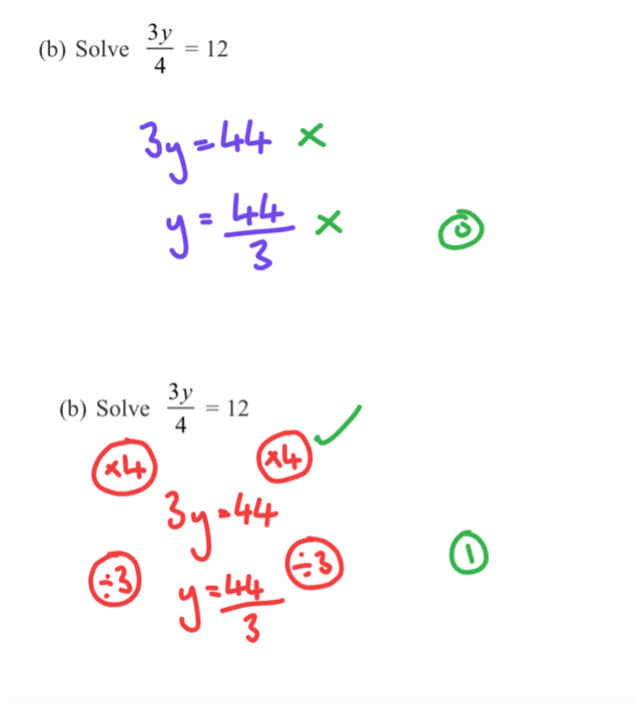
This is a two-mark question, requiring students to solve a two-step equation. In both responses, the students attempted to multiply both sides of the equation by 4 as step one. The purple response has not made this step explicit, while the red response has (see the x4 in circles). The students both then go on to make a calculation error. 12 x 4 = 48, not 44. The red response picked up the process mark, but the purple does not. The second mark is for an accurate answer – neither student scores this mark, as their answers are incorrect.
Despite the students doing the same thing, one scores a mark while the other does not. Across three papers and 240 marks, every mark matters and could mean the difference between grades! What does this mean when supporting young people? Do not just talk about working out – but talk about making our steps explicit. The examiner should be certain what step is being taken at every stage.
None of these suggestions require students to spend hours doing extra maths. Instead, they encourage students to revise more effectively. Small habits—such as learning key formulae, practising written explanations and making each step of their working explicit—can make a real difference when every mark counts.